Would You Too?A Percentage Guessing Game
Your phone buzzes mid-story. Would you peek? Guess the percentage who picked your answer, then see how close you came.
Play 3 questionsPlay the percentage guessing game
Guess the percentage: a sample reveal
Example only. The counts below are fictional.
Your range: 25–49%Sample result: 24%
How to guess the percentage
Choose honestly
Fixed options, no trivia and no wrong answers. Just what you'd do.
Guess the crowd
Guess the percentage by tapping one range, from Few to Most.
Feel the gap
See the count behind the percentage and how close your guess was.
How close was your percentage guess?
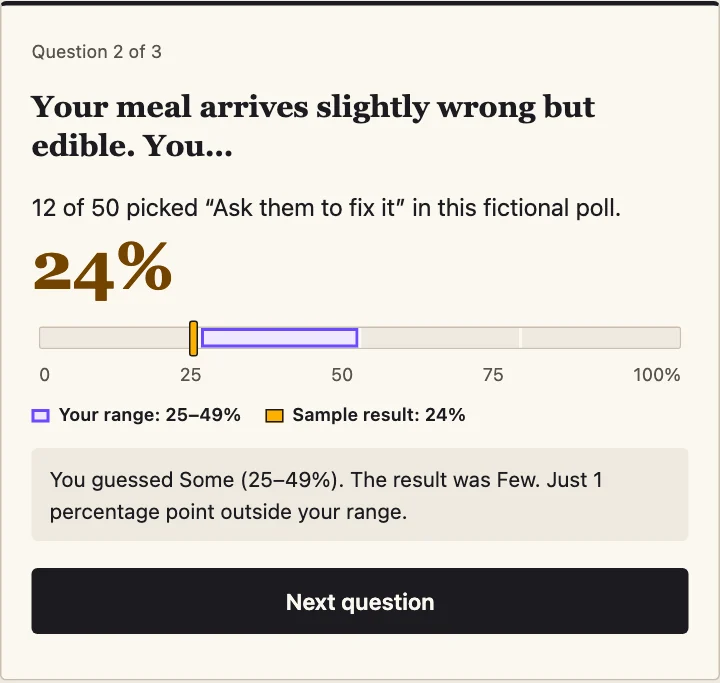
Try a percentage guess for the meal in the example above. You ask for it to be fixed and guess that Some people would do the same. The purple band shows the whole range you picked, from 25% to 49%. The amber marker shows where the sample landed. Twelve people out of fifty chose your answer, so the marker sits at 24%, just to the left of your band.
Now imagine one more person in that same group had picked your answer. Thirteen out of fifty would be 26%, inside your band. Your percentage guess stays the same. One extra response moves the result across the edge of the range. When a result surprises you, look at the count as well as the range.
Try these poll prediction tips before your next round.
Copy your result after question three. Your friend can see how close your percentage guesses were, but your choices stay hidden. Did you both expect the same answer to be popular?
How this percentage guessing game works
Would You Too? is a percentage guessing game about everyday choices. First choose the option closest to what you would do. Then guess the percentage of the sample that picked that same option. The reveal shows the count, the percentage, and whether that result falls inside your range.
That order matters. Your answer is personal, while your percentage guess is about a group. You might ask a restaurant to correct an order because that feels straightforward, then wonder whether most other people would do the same. The game separates those two decisions so you can see where your intuition matches the sample and where it does not.
Choose one of four percentage ranges
After choosing an answer, select a range for the share of responses that match it. Few means 0–24%. Some means 25–49%. Many means 50–74%. Most means 75–100%. Each range is a percentage guess, so you can play without entering a number or doing mental arithmetic.
The labels describe ranges, not grades. “Most” is a broad prediction that at least three quarters of the sample chose your answer. “Some” runs from a quarter up to, but excluding, half. If you are unsure whether the result will land near a boundary, choose the range you think is more likely and see how close you came.
Your percentage guess can land on target even if you don’t know the exact count. If 30% chose your answer, Some contains the result. Many begins at 50%, a full twenty points higher. The result screen gives the actual percentage and shows your selected range, making that distinction visible.
Read the count as well as the percentage
Imagine a sample of 50 responses. If 12 people chose the option you picked, the share is 12 divided by 50, or 24%. That is one percentage point below the Some range, which begins at 25%. The range misses, although the result is close to its edge. This is why a one-range difference does not always mean your estimate was wildly wrong.
If one more response in the same 50-person sample had chosen that option, the count would be 13 out of 50, or 26%. Your original percentage guess would not change, but the result would move inside Some. Looking at the numerator and denominator explains how a small count difference can change the label, especially in a small sample.
The example board contains fictional counts created to demonstrate the reveal. It is not a live poll, a published survey, or a report of what real visitors chose. Playing the sample board does not add a response or update the results. The three rounds use the same fixed examples for everyone.
Try the same reasoning on three everyday situations
The sample asks what you would do when a friend is telling a story and your phone buzzes, when a meal arrives slightly wrong but is still edible, and when your alarm goes off. Each question offers four concrete responses. Select the one that fits you, then guess the percentage of the 50 fictional responses that match.
For the phone question, “check it now” and “glance discreetly” may both involve looking at the screen, but the board counts them as different answers. If you choose “glance discreetly,” your percentage guess concerns that exact option. It does not include people who check immediately. Read the wording of your choice carefully before you guess the percentage.
For the meal question, the fictional board has 12 of 50 choosing “Ask them to fix it.” That produces 24%. The percentage guess in the example is Some, which starts at 25%, so it lands just outside the range. This illustrates the scoring boundary and does not suggest that 24% of actual diners would ask for a correction.
For the alarm question, “Snooze once” and “Snooze several times” are separate responses too. If you pick “Snooze once,” guess the percentage for that choice alone. The current board does not combine similar answers into a larger category, and the reveal shows the count for your selected answer.
What your three percentage guesses tell you
At the end of three questions, your summary shows how many ranges away each percentage guess was from the sample result. An on-target percentage guess means the percentage landed in the range you chose. A result one range away means the percentage fell into a neighboring bucket. The summary does not rank your personality, tell you which choice is best, or measure how representative the sample is.
You can play again and choose a different option to explore another outcome. On a replay you can test a new percentage guess against the same sample. A friend can also play the sample on another device and compare the ranges in your copied summaries.
When comparing results, ask which percentage guess surprised you and what clue you used. Maybe the options sounded equally plausible, or one answer felt more socially acceptable than another. Those are useful ways to explain your reasoning, but the game does not claim to measure why the fictional responses have their values.
Play in a few minutes, on a phone or computer
The game runs in a web browser. There is no app to install, account to create, or group to assemble. Start a round, make three choices, make three percentage guesses, and read the reveals. Buttons are used for each option, so you can play by tapping on a phone or clicking with a mouse.
If a round does not begin, enable JavaScript for the page and reload it. The sample board is part of the page, and its play controls need JavaScript to advance between choosing, predicting, and revealing. Reloading starts the board from the beginning.
Start the sample percentage guessing game whenever you are ready.
Try a percentage guess out loud
Suppose you pick “Snooze once” and picture a dozen people out of fifty doing the same. Before you tap, say your percentage guess out loud. Doubling twelve gives you 24 out of 100, so you would choose Few. If you had pictured fifteen people instead, your percentage guess would be 30%, inside Some. That little exercise lets you change your mind before you see any results. After the reveal, compare the count you pictured with the count on the screen.
Percentage guessing game FAQ
How do I play?
Would You Too? is a solo percentage guessing game about everyday choices. Choose your answer, then picture how many people picked it: under a quarter, a quarter to just under half, half to just under three quarters, or three quarters or more. The result appears as soon as you choose a range.
Are there right answers?
Every personal choice is valid. The reveal shows whether the sample percentage fell inside your range. After three percentage guesses, your summary shows “on target” or how many ranges off you were for each guess.
Where do the numbers come from?
This sample board uses fictional counts to show how the game works. Each question has 50 fictional responses. Playing a round does not add a vote or change the percentages. See what stays in your browser.
Can I play alone?
Yes. You can finish all three questions without an account or someone else online and copy your result to share when you finish. A friend can play the same board on their own device.
Do I get new questions when I play again?
Play again starts the same three questions. Make a percentage guess for a different choice to see the result for that answer.
What if the game won’t start?
Open the game in your browser with JavaScript enabled, reload the page, then tap Play 3 questions. Reloading starts a fresh round.
Compare percentage guesses with a friend
Play separately, then compare: which percentage guess surprised you most?
Play 3 questions